Ask ten hiring managers whether they read cover letters and you will hear ten different answers. Some read every one. Others skip straight to the resume. So is it worth the effort? In most cases, yes, and the reasons are practical. A strong cover letter gives you space to explain what a resume cannot, and it can tip the balance when two candidates look similar on paper. This article explains when cover letters matter, what makes one effective, and how a cover letter writer can save you time without making your application sound generic.
Do employers actually read cover letters?
Honestly, it depends. Practices vary between companies, roles, and even individual recruiters. A large employer processing thousands of applications may barely glance at them. A small company, a nonprofit, or a hiring manager who reads every application personally is more likely to read closely. When a job posting asks for a cover letter, you should assume someone will read it, and a missing or careless one can count against you.
The safest way to think about it is this: a cover letter costs you an hour, and it might be the reason you get an interview. The risk of skipping it is higher than the risk of writing it.
What a cover letter does that a resume cannot
A resume is a list of facts. A cover letter connects those facts into a reason to hire you.
- It tells your story. You can explain why this role and this company make sense for you now.
- It links your experience to their needs. You can pick two or three achievements and show how they solve the problems in the job description.
- It explains what looks unusual. A career change, a gap, or a move to a new city is easier to understand when you explain it in your own words.
- It shows how you communicate. Clear, warm, concise writing is evidence of a skill most jobs require.
- It shows real interest. A specific reference to the company's work tells the reader you did your homework.
When a cover letter matters most
Write one, and put extra care into it, in these situations:
- The job posting asks for a cover letter or a "statement of interest."
- You are changing careers or industries.
- You are applying for a role in writing, communication, sales, or client service, where the letter itself is a work sample.
- You are a recent graduate with limited experience and need to show potential.
- The company is small, or you are applying through a personal referral.
- You have an employment gap or a move to explain.
When you can keep it short
If an application form marks the cover letter as optional and asks you to upload it with a single click, a short, focused note is still better than nothing. Three brief paragraphs that show why you fit can be enough. What you should avoid is uploading a generic letter that could be sent to any company, because it signals that you did not try.
How to tailor a cover letter in ten minutes
Tailoring sounds time-consuming, but a simple routine keeps it fast. First, read the job description and note the three requirements that appear most often. Second, choose one achievement from your past that proves each requirement. Third, find one detail about the company, such as a product, a value, or a recent project, and explain in a sentence why it appeals to you. Finally, write the opening and closing fresh for each application, and reuse the middle only if it truly fits. This routine gives you a letter that feels personal while still respecting your time, especially when you are applying to several roles in the same week.
What makes a cover letter weak
Most weak letters fail for the same reasons:
- They repeat the resume. The reader has already seen it. Add context, not a copy.
- They are generic. If you can swap the company name and the letter still works, it is not specific enough.
- They open with clichés. "I am writing to apply for the position of..." wastes your best line.
- They are too long. Aim for about 250 to 350 words, which fits on one page.
- They focus on what you want. Show what you can do for the employer first.
- They contain mistakes. Typos and a wrong company name are hard to recover from.
How an AI cover letter writer can help
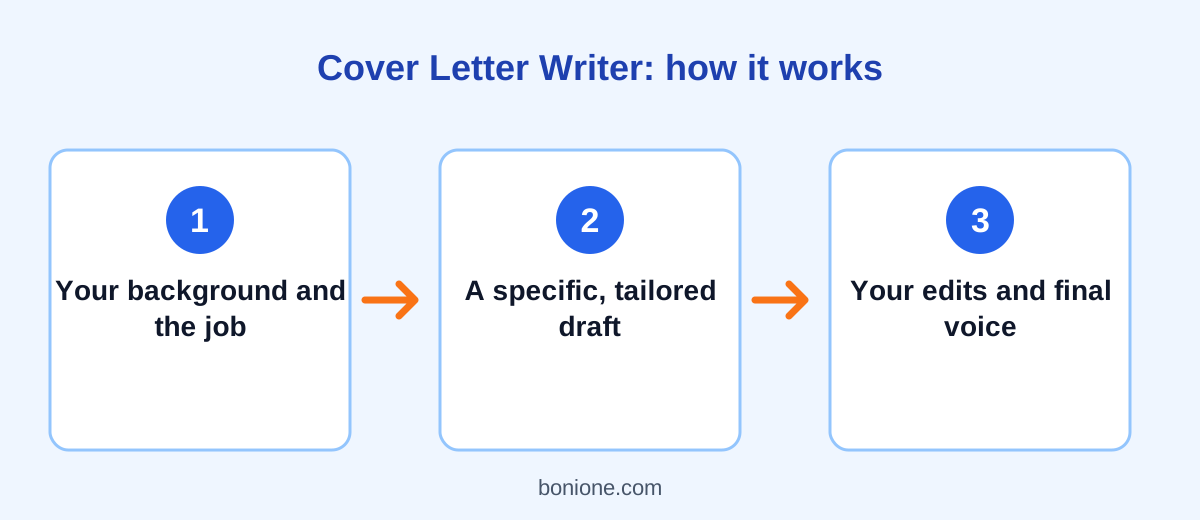
The hardest part of a cover letter is often the blank page. A cover letter writer removes that barrier. You provide your background and the job details, and it returns a structured draft with an opening, evidence from your experience, and a closing that asks for a conversation.
Our free Cover Letter Writer also lets you choose a tone, such as professional, friendly, confident, or enthusiastic, so the draft fits the company. You can write your details in another language and the letter will follow it.
There are limits, and it is important to respect them. An AI draft is a starting point, not a finished letter. It does not know the company's culture, and it can only work with the details you provide. Before you send anything:
- Check that every fact is true and every date is right.
- Add one detail that only you could write, such as a project you loved or a reason the company's mission matters to you.
- Remove any phrase that does not sound like you.
- Read it aloud and shorten long sentences.
Final thoughts
Cover letters still matter because they do a job your resume cannot: they show who you are and why you are a good match. You do not need beautiful prose. You need a clear, specific letter that links your experience to the employer's needs. A cover letter writer can get you to a solid draft quickly, and your edits can make it truly yours.
Ready to write yours? Try the free Cover Letter Writer, and use our guide on how to write a cover letter that gets read to polish the final version.