A good cover letter is short, specific, and easy to read. It does not need clever wording. It needs a clear reason why you are a strong match for this job at this company. This guide shows you how to write a cover letter step by step, with a structure you can follow and a template you can adapt.
Step 1: Research the role and the company
Before you write a word, spend ten minutes on preparation. Read the job description twice and underline the three things the employer cares about most, such as managing customers, analyzing data, or leading a small team. Then look at the company's website, recent news, or social media to understand what they do and how they talk about it. You are collecting two things: the problems the role must solve, and one detail about the company that genuinely interests you.
Step 2: Choose two or three achievements
You cannot cover your whole career in one page, so choose the two or three experiences that best prove you can meet the needs you underlined. For each one, note what you did and what happened as a result. A short story with a result beats a list of skills. If you are early in your career, use a class project, an internship, volunteer work, or a personal project.
Step 3: Use a simple structure
A reliable cover letter has four parts.
- A header. Your name, email, phone number, the date, and the hiring manager's name if you can find it.
- An opening paragraph. Say which role you are applying for and give a specific reason you are interested.
- One or two body paragraphs. Connect your achievements to the employer's needs.
- A closing paragraph. Restate your interest, thank the reader, and suggest a next step.
Keep the whole letter between 250 and 350 words, which fits comfortably on one page.
Step 4: Write a strong opening
Your first two sentences decide whether the reader keeps going. Skip "I am writing to apply for the position of..." and lead with something concrete: a result you achieved, a reason the company's work matters to you, or a connection to the role.
Weak: I am writing to apply for the Marketing Coordinator position at Northwind.
Stronger: When I grew our student club's newsletter from 40 to 400 subscribers, I discovered that I love turning small ideas into steady audiences. That is why the Marketing Coordinator role at Northwind excites me.
Replace the numbers with your own true figures, and never exaggerate.
Step 5: Link your experience to their needs
In the body, tell one brief story per paragraph. Name the challenge, your action, and the result, then connect it to the job. Use the employer's language from the posting, so the reader sees the match quickly. Focus on what you can do for them instead of what you hope to get from the job.
A cover letter template you can adapt
Dear [Hiring Manager's name],
[Opening: one or two sentences about the role and a specific reason you are interested in the company.]
In my role as [job title] at [company], I [achievement with a result]. This experience taught me [skill or insight], which I would bring to [their goal or challenge from the job posting].
I also [second achievement, project, or skill] that helped [result]. I am comfortable with [tool or method from the job description], and I enjoy [something that fits the role].
I would welcome the chance to discuss how I can help [company] with [specific need]. Thank you for your time and consideration.
Sincerely,
[Your name]
Step 6: Close with confidence
End with a clear, polite call to action. "I would welcome the chance to talk about how my experience can support your team" is direct and courteous. Avoid apologizing for a lack of experience or saying "I hope you will consider me." Thank the reader and finish.
Step 7: Edit, proofread, and format
Read your letter aloud, then cut anything that does not support your main message. Check the company name, the job title, and the spelling of the hiring manager's name. Use a clean font at 10 to 12 points and save the file as a PDF with a clear name such as "Firstname-Lastname-Cover-Letter."
Common cover letter mistakes to avoid
- Sending one generic letter to every employer.
- Repeating your resume line by line.
- Opening with clichés or vague praise for the company.
- Writing more than one page.
- Forgetting to update the company name from a previous application.
- Listing personality traits without evidence, such as "team player" or "hard-working."
Get a draft faster with the Cover Letter Writer
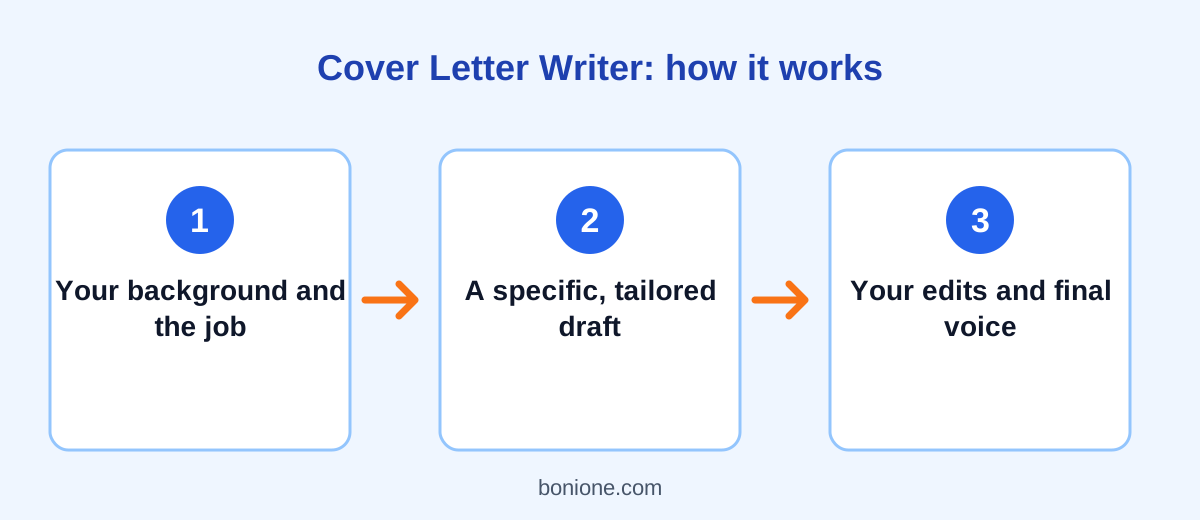
If you are stuck on the first draft, use our free Cover Letter Writer. Add your background, the job title, the company, and the job description, and choose a tone. You will get a tailored draft of about 300 words that follows the structure above. Then edit it: add a personal detail, verify every fact, and make the voice your own.
If you feel stuck at any step, remember that the first draft does not need to be good. It only needs to exist. Write everything you would like to say, then cut it down to the strongest points. Editing a rough draft is far easier than staring at a blank page, and each round of edits will make the letter clearer and more confident.
Frequently asked questions
Should I address the letter to a specific person?
Yes, when you can find a name on the company website or on a professional networking profile. If not, "Dear Hiring Team" is a respectful and acceptable choice.
Do I need a cover letter if I already have a strong resume?
It is usually worth writing one, especially if the posting requests it. Read more in our article on whether cover letters still matter.
Can I use the same letter for several jobs?
Use the same structure, but rewrite the opening and the body for each role. A letter that clearly speaks to one employer is far more persuasive than a general one.
Final thoughts
A strong cover letter follows a simple recipe: research the employer, pick two or three relevant achievements, open with something specific, connect your experience to their needs, and close with confidence. Keep it to one page, keep it honest, and make it sound like you.