Most interviews are built from the same handful of questions. Interviewers ask about your background, your strengths, a time you solved a problem, and why you want the job. The wording changes, but the goal is always the same: to find out whether you can do the work and work well with others. This guide shows you how to answer common interview questions with clear structure, using the STAR method and simple formulas you can adapt to your own experience.
What interviewers are really asking
Behind every question is a hidden one. "Tell me about a conflict with a coworker" really means "Can you handle disagreement professionally?" "Why do you want this job?" means "Have you thought about this role, and will you stay motivated?" When you understand the hidden question, your answer becomes more focused. Before you speak, ask yourself what quality the interviewer wants to see, then choose an example that shows it.
The STAR method explained
STAR is a simple framework for behavioral questions, the ones that begin with "Tell me about a time when..." It keeps your story organized and makes sure you mention the most important part, which is the result.
- Situation: Set the scene in one or two sentences. Where were you, and what was happening?
- Task: What was your responsibility or goal?
- Action: What did you personally do? This is the longest part. Say "I" rather than "we" when describing your actions.
- Result: What happened because of your actions? Include a number if you honestly have one, and what you learned.
Aim for about ninety seconds to two minutes for the whole answer.
A sample STAR answer
Question: "Tell me about a time you handled a difficult customer."
Situation: In my last job at an electronics shop, a customer came in upset because a repair had taken twice as long as promised.
Task: I needed to calm the situation and find a fair solution without breaking store policy.
Action: I listened without interrupting, apologized for the delay, and checked the repair status in the system. Then I offered a free protective case and called him personally when the device was ready.
Result: He collected his device the next day, thanked me, and later bought an accessory. My manager asked me to train new staff on handling complaints.
Notice that the answer is specific, honest, and ends with a result. Use your own true story in the same shape.
How to answer "Tell me about yourself"
This is usually the first question, and many people ramble. Use the present, past, future formula:
- Present: Who you are professionally right now and what you focus on.
- Past: One or two highlights from your experience that relate to this job.
- Future: Why this role is the logical next step.
For example: "I'm a customer support specialist who helps a busy online store resolve orders and returns. Over the past three years I improved our help-center articles and trained new team members. I'm now looking for a role where I can work more closely with product teams to prevent problems, which is why this position appeals to me." Keep it under a minute and leave out personal details that do not relate to the job.
How to answer "What is your biggest weakness?"
Choose a real weakness that is not essential for the job, then show what you are doing about it. Avoid disguised strengths such as "I work too hard." A better answer names the issue, gives a brief example, and describes your improvement: "I used to avoid asking for help, which slowed me down on complex tasks. Now I set a time limit on solving a problem alone, and then I ask a colleague. It has helped me deliver more reliably."
How to answer "Why do you want this job?"
Connect three things: what interests you about the role, what you bring, and what draws you to the company. Do your research first. Mention a specific product, value, or project, and link it to your skills. Avoid answers that focus only on salary or convenience. Interviewers want to hear that you have chosen this job on purpose.
Build a story bank
Instead of preparing a different answer for every question, prepare five or six flexible stories from your experience. Good topics include:
- A goal you achieved or exceeded.
- A mistake you made and what you learned.
- A conflict or disagreement you resolved.
- A time you led or helped others.
- A time you learned something quickly.
- A time you worked under pressure or a tight deadline.
Write each story in STAR form, then practice adapting it. One strong story can answer several different questions.
Practice before the real interview
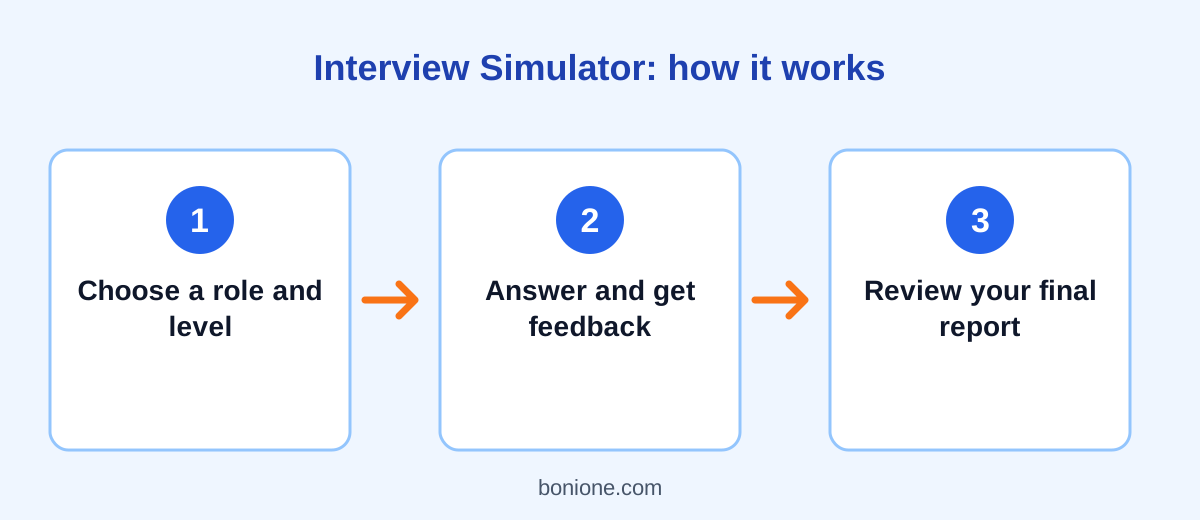
Reading advice is not the same as speaking. Practice your stories aloud, ideally with feedback. The free Interview Simulator asks role-specific questions one at a time and comments on each answer, then gives you a report at the end. To understand why this kind of practice works, read why to use an AI interview simulator.
Mistakes to avoid
Even well-prepared candidates fall into a few predictable traps. Knowing them in advance makes them easy to avoid, especially when nerves make it harder to think clearly during the conversation itself.
- Giving answers that are too long and lose their point.
- Saying "we" for everything, so your own role stays unclear.
- Telling a story with no result.
- Criticizing a former employer or coworker.
- Memorizing a script word for word, which can sound unnatural.
- Not preparing any questions to ask the interviewer at the end.
Final thoughts
Strong interview answers are not about perfect words. They are about clear structure and honest, specific examples. Learn the STAR method, prepare a small bank of stories, and use the present, past, future formula for your introduction. Then practice out loud until your answers feel natural.
Before you go, make sure your application materials are ready too. Refine your resume with the Resume Optimizer and check the fit with the Job Match Analyzer.