Negotiating a salary can feel uncomfortable, but a clear process makes it much easier. You do not need to be aggressive or clever. You need to be prepared, polite, and specific. This guide walks you through how to negotiate salary step by step, with scripts you can adapt for email and phone, and answers to the pushback you are likely to hear.
This guide offers general information, not financial or legal advice.
Step 1: Get the offer, and respond with enthusiasm
Wait until you have a real offer before negotiating in detail. When it arrives, thank the employer and show enthusiasm for the role. Then ask for the details in writing, including base pay, bonus, benefits, leave, and the start date. It is perfectly normal to say, "Thank you, I am excited about this opportunity. Could I take until Thursday to review the details?" A short pause gives you time to prepare.
Step 2: Research a realistic range
Your request should rest on facts, not guesses. Look at several sources for your role, location, and level of experience:
- Official labor statistics and government job data, where available.
- Salary reports and industry surveys.
- Job postings that list pay ranges.
- Conversations with people in similar roles.
Since pay varies by country, city, industry, and company size, treat any single number with caution. Note a range, then narrow it based on your experience and the employer.
Step 3: Decide your three numbers
Before you talk to anyone, write down:
- Your target: What you would be happy to receive.
- Your acceptable minimum: The lowest package you would take.
- Your walk-away point: The point below which you would decline.
Ask for a figure slightly above your target, so you have room to move while still landing on a number you like. Remember to look at the whole package, not only the base salary.
Step 4: List your value
Employers pay for results. Write down three to five points that support your request:
- Relevant experience and specific achievements, with results where you can honestly measure them.
- Skills or certifications that match the job description.
- Extra responsibilities you are ready to take on.
- Evidence of fast learning or strong references.
Keep each point short and factual. Never exaggerate or mention another offer that does not exist.
Step 5: Make your ask
Use a calm, collaborative tone. State your enthusiasm, your request, and your reasons in a few sentences. Then stop talking and let the other person respond.
Email script
Dear [Name],
Thank you again for the offer to join [company] as [job title]. I am very excited about the role and the team.
After reviewing the details, I would like to ask whether there is flexibility on the base salary. Based on my [years] of experience in [field], my work on [specific achievement], and the responsibilities of this role, I was hoping for a base salary of [your figure]. I am confident I can contribute quickly, especially on [priority from the job description].
I would be glad to discuss this further. Thank you for your consideration.
Best regards, [Your name]
Phone script
"Thank you again for the offer. I am really excited about this role. I have reviewed the package, and I was hoping we could talk about the base salary. Given my experience with [skill] and the results I achieved in [project], I would like to ask for [figure]. Is there flexibility there?"
Then pause. Silence is normal and gives the other person time to think.
Step 6: Handle common pushback
"That is above our budget." Reply: "I understand. Is there flexibility in other parts of the package, such as a signing bonus, extra leave, or a salary review after six months?"
"This is our standard offer." Reply: "I appreciate that. I would still like to find a way to make this work. Would it be possible to revisit the salary after a first performance review?"
"What is your current salary?" Where the law allows, you can redirect: "I would prefer to focus on the value I bring to this role and the range you have budgeted. Could you share the range for this position?"
"We need an answer today." Reply: "I am very interested, and I want to make a well-informed decision. Could I have until tomorrow to confirm?"
Step 7: Negotiate the full package
If the base pay does not move, look at the rest of the offer. You can ask about a signing bonus, a review date, extra vacation, remote work, training budget, equipment, or a title that fits your responsibilities. Decide in advance which items matter most, so you can trade them wisely. For example, you might accept a slightly lower salary in exchange for flexibility or a guaranteed review.
Step 8: Get the agreement in writing
Once you reach an agreement, ask for an updated offer letter that shows every detail, and read it carefully before you accept. Confirm the salary, bonus, start date, benefits, and any promises you discussed. Do not resign from your current job until the final terms are in writing.
Prepare with the Salary Negotiation Coach
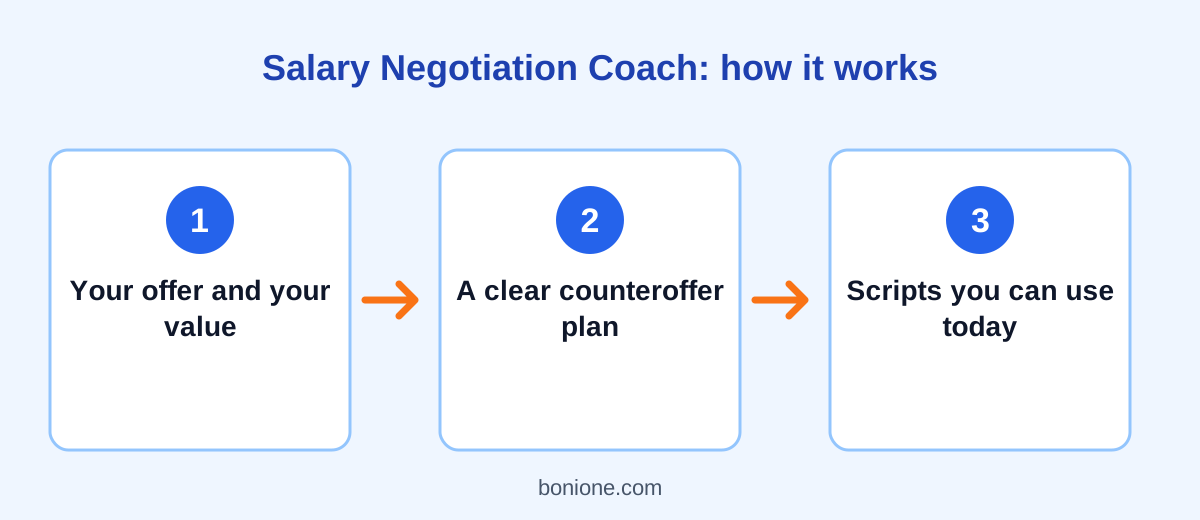
Our free Salary Negotiation Coach can turn these steps into a plan for your situation. Describe your offer and your value, and add your target if you have one. You will get a position summary, a clear ask with a fallback, email and phone scripts, likely pushback with replies, other items to negotiate, and next steps if the answer is no. It does not quote market salaries, so bring your own researched figures. To learn more about its role, read why you should negotiate your salary.
Mistakes to avoid
- Accepting immediately out of nervousness.
- Naming no number and saying only, "Can you do better?"
- Giving an ultimatum or a threatening tone.
- Inventing a competing offer.
- Focusing only on salary and ignoring benefits and growth.
- Negotiating by text message about complicated details. Use email or a call.
- Forgetting to say thank you after the discussion.
Frequently asked questions
How much should I ask for?
It depends on your research, your experience, and the role. Many people ask for a modest increase above their target, supported by clear reasons. Use figures from reliable local sources instead of a fixed percentage.
Can I negotiate a raise at my current job?
Yes. Gather evidence of your results, research pay for your role, and request a meeting. Present your achievements and your ask calmly, and be ready to discuss a timeline if the answer is not immediate.
What if the employer says no?
Stay professional. You can ask what would be needed to earn a raise later, or negotiate other benefits. Then decide whether the full package still works for you.
Final thoughts
To negotiate salary well, follow a clear sequence: get the offer in writing, research a fair range, decide your numbers, list your value, make a polite ask, handle pushback calmly, consider the whole package, and confirm the final terms. Preparation is what turns an uncomfortable moment into a confident conversation. Start with the Salary Negotiation Coach, and make sure your resume shows your strongest results with the Resume Optimizer.