When a job search feels slow, the natural reaction is to send more applications. Fifty resumes in a week feels productive, but it often leads to the same silence. The problem is rarely a lack of effort. It is a lack of fit and focus. A job match analyzer helps you see, before you apply, how closely your resume matches a job posting, what is missing, and whether the role deserves your time. This article explains why that insight matters and how to use it wisely.
The "apply to everything" trap
Sending the same resume to every job is tempting because it is fast. But hiring teams write postings around specific needs: certain tools, certain responsibilities, certain kinds of experience. A general resume that never mentions those needs makes it hard for the reader to see the connection, even when you could do the job well.
The opposite mistake also exists: talking yourself out of roles you could actually win. Many people skip a posting because they meet seven of ten requirements and assume that is not enough. Without an objective comparison, both mistakes are easy to make.
There is also a hidden cost to mass applications: they leave little time for quality. Each application deserves at least a quick check of the requirements and a few targeted edits. Ten thoughtful applications will usually teach you more, and produce better results, than a hundred identical ones, because you can learn from each response and adjust your approach.
What a job match analyzer does
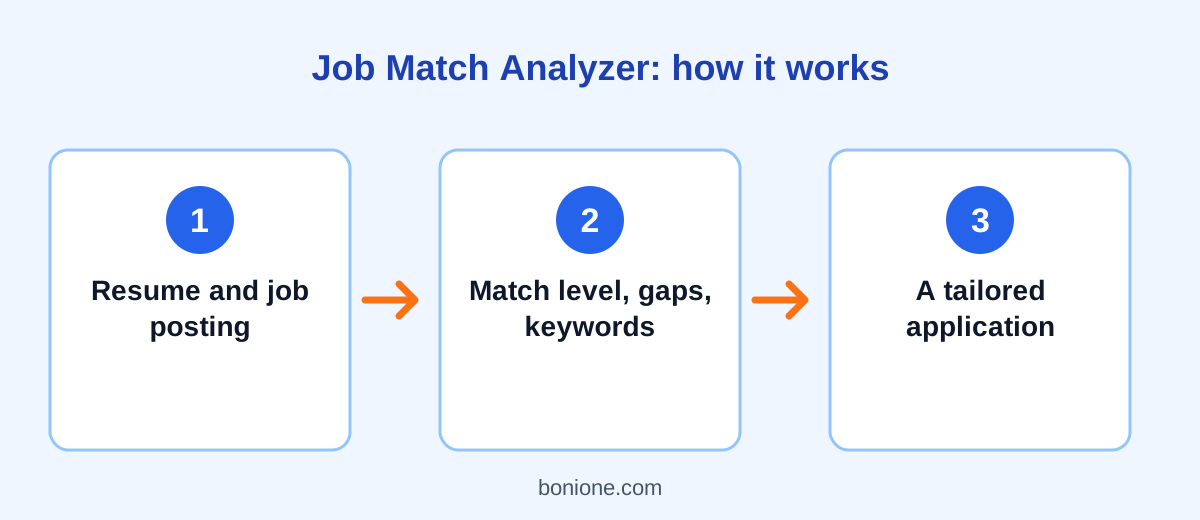
A job match analyzer takes two texts: your resume and the job description. It compares the skills, experience, and keywords in the posting with what appears in your resume, then reports the results. A good report includes an overall match level with a reason, the areas where you are strong, the gaps and risks, the keywords that are missing, and specific edits to make before you apply.
Our free Job Match Analyzer follows this format. It also gives a direct recommendation on whether to apply, so you are not left with a pile of data and no decision.
Five reasons to use one
1. It saves time
Reading a long job description and comparing it line by line with your resume is slow work. An analyzer does the first pass in seconds, so you can spend your energy on the edits that matter.
2. It helps you focus on the right jobs
When you see a weak match with several critical gaps, you can move on with confidence. When you see a moderate match with gaps you can address, you know where to put your effort. Either way, you make choices with evidence.
3. It shows you the words employers use
Different employers describe the same skill in different ways. The analyzer surfaces the exact terms in the posting, so you can use the same wording wherever it truthfully applies to your experience. This helps both applicant tracking systems and human readers understand you quickly.
4. It reveals gaps early
Perhaps the posting asks for experience with a certain tool that you have never used. Knowing this in advance lets you decide whether to learn the basics, mention a related skill, or address the gap in your cover letter, rather than being surprised in an interview.
5. It makes tailoring practical
Tailoring a resume for every application sounds exhausting. When you know precisely which three or four edits will improve the match, tailoring becomes a short task instead of a rewrite.
What a job match analyzer cannot do
No tool can see the whole picture. It does not know how many people applied, how the company weighs different requirements, or whether an internal candidate is favored. A "weak" match is not a verdict on your worth, and a "strong" match does not promise an interview. Job postings can also be inflated, listing wishes as if they were rules.
The analysis is also only as good as the text you provide. If your resume leaves out relevant experience, the report will underestimate your fit. That is why it is worth improving the resume first with the Resume Optimizer, and then testing the match.
How to read a match report
- Match level: Treat it as a guide, not a grade. A moderate match with strong core skills can be worth pursuing.
- Where you match: Make sure these strengths appear near the top of your resume.
- Gaps and risks: Sort them into gaps you can close, gaps you can explain, and gaps that are truly essential.
- Missing keywords: Add only the terms that honestly describe your experience.
- Recommended edits: Do the top two or three, then run the comparison again.
A simple workflow
- Find a job you are interested in and copy the full description, including the requirements.
- Paste it, together with your current resume, into the analyzer.
- Read the report and choose the edits that are true and useful.
- Update your resume. For a step-by-step method, read how to tailor your resume to a job description.
- Write a cover letter that addresses the biggest gap and highlights your strongest match.
Common questions
Is it better to apply only to strong matches?
Not always. Many hiring managers are flexible on some requirements. A moderate match can succeed when you show relevant results and a clear willingness to learn. Use the report to choose how to present yourself, not only whether to apply.
How often should I run it?
Run it for each job you are seriously considering. A few well-tailored applications usually work better than dozens of untouched ones.
Should I copy the job description keywords into my resume?
Only where they are true. Adding skills you do not have can backfire in an interview.
Final thoughts
Job searching is about making good decisions with limited time. A job match analyzer supports those decisions by showing you how your resume lines up with a role, which gaps matter, and what to change. Use it to apply smarter, tailor with purpose, and spend your effort on the roles where you can genuinely stand out.
Try the free Job Match Analyzer with your next target job.