A tailored resume is one that shows, quickly and honestly, why you fit a specific job. It does not require a rewrite from scratch. With a clear method you can adapt your resume to a new job description in about fifteen minutes. This guide walks through the process step by step, including how much time to spend on each part, so that tailoring becomes a habit instead of a chore.
Why tailoring works
Recruiters and hiring managers read with one question in mind: can this person do the job we are hiring for? If your resume makes the answer obvious in the first few seconds, you have an advantage. If they must dig through unrelated details to find it, many will not bother. Tailoring moves your most relevant evidence to the front and uses the employer's own language to describe it.
It also helps with applicant tracking systems, which employers often use to search and filter applications. Matching your wording to the posting, where it is true, makes you easier to find.
Tailoring also saves you effort in the long run. Once you have practiced the method a few times, you will start to notice common patterns across postings in your field, and many of your edits will become quick and automatic. That is why a short, repeatable routine works better than occasional heroic rewrites when a perfect job appears.
Before you start: keep a master resume
Keep one complete master resume that lists all your jobs, projects, skills, and achievements, even if it runs long. When you apply, copy it and trim it down to a focused version. This way you never lose good material, and you always start from a strong base instead of a blank page.
Step 1 (3 minutes): Mark what the employer wants
Read the job description carefully and highlight three groups of information:
- Must-have skills and tools that appear in the requirements section.
- Responsibilities described in the first lines of the duties.
- Repeated words, since anything mentioned more than once is probably a priority.
Pick the top five to eight items. These are your target keywords.
Step 2 (3 minutes): Match requirements with your evidence
Make a quick two-column list. On the left, write each key requirement. On the right, write your best honest proof: a job, a project, a result, a course, or a tool you have used. For example:
| Requirement | Your evidence |
|---|---|
| Manage social media | Ran three accounts at my last job, grew followers |
| Email campaigns | Built a monthly newsletter in a student project |
| Analytics | Weekly reports in Google Analytics |
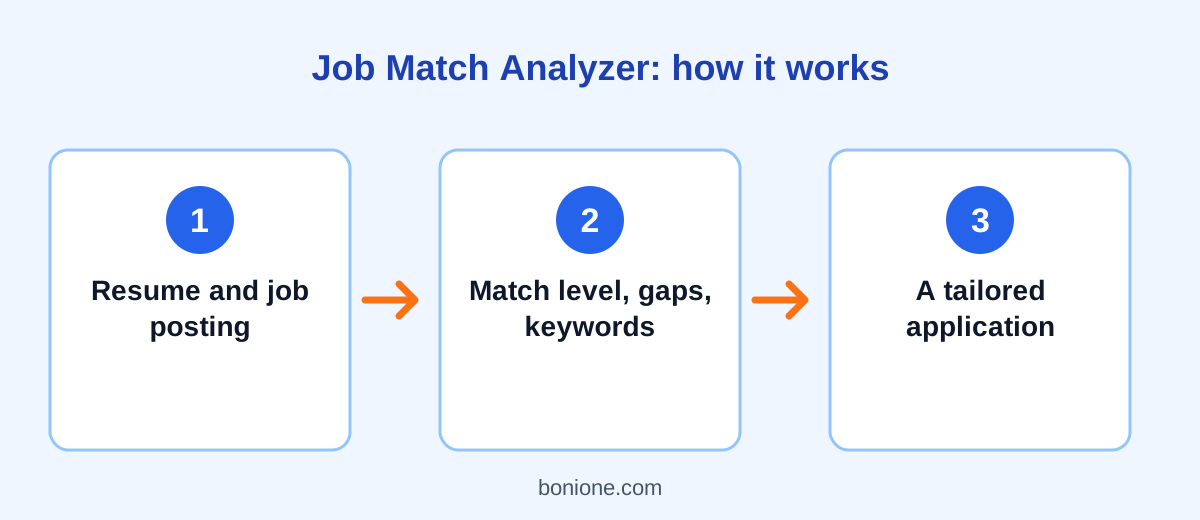
If a requirement has no evidence, note it as a gap. You will decide later whether to learn it, mention something related, or address it in your cover letter. If you want a faster comparison, the Job Match Analyzer does this step for you and lists missing keywords.
Step 3 (3 minutes): Rewrite your summary
The top of your resume is prime space. Replace your general summary with two or three lines that name the role you want, your strongest relevant skills, and one proof point. For example:
Marketing coordinator with three years of experience in social media and email campaigns. Skilled in content planning and Google Analytics, with a record of growing engaged audiences.
Use only what is true, and use the employer's wording where it fits, such as "email campaigns" instead of "newsletters" if the posting says so.
Step 4 (3 minutes): Reorder and edit bullet points
Within each job, place the bullets that best match the posting first. Rewrite the most relevant ones to include a result and a keyword. Cut or shorten bullets that do not support this application. A tailored resume is often shorter than the master version, because it leaves out what the reader does not need.
Use the formula action verb, task, and result: "Managed three social media accounts and grew Instagram followers by [add number] through a weekly content calendar." Replace the placeholder with your actual figure.
Step 5 (2 minutes): Adjust your skills section
Reorder your skills so that the ones in the posting come first. Remove skills that are outdated or unrelated. Group them if the list is long, such as "Marketing tools," "Analytics," and "Languages." Only list skills you could discuss confidently in an interview.
Step 6 (1 minute): Proofread and save
Check the job title, spelling, dates, and consistency. Save the file with a clear name, such as "Firstname-Lastname-Resume-CompanyName." If you want a second opinion, paste the final version into the Resume Optimizer for feedback on wording and structure.
Where tailoring goes wrong
- Keyword stuffing. Repeating a term twenty times does not help. One or two natural mentions in context are enough.
- Claiming skills you do not have. An interviewer can test you on anything written in your resume.
- Ignoring the whole picture. Changing only the summary but leaving every bullet unchanged rarely works.
- Forgetting the cover letter. Your resume and letter should tell the same story. Learn how in our guide to writing a cover letter.
- Losing your original. Always save each version under a new name.
Frequently asked questions
Do I need to tailor my resume for every application?
For jobs you truly want, yes. Fifteen minutes of focused edits usually beats a generic resume. For a general role in a familiar field, a well-written base resume with small tweaks may be enough.
How many keywords should I add?
Add the ones that are both important to the employer and true for you. Quality matters more than quantity, and a handful of well-placed terms is better than a long list.
What if I meet only some of the requirements?
Apply if you meet the core ones and can show related strengths. Many postings describe an ideal candidate that rarely exists.
Final thoughts
Tailoring a resume is a short, repeatable process: mark what the employer wants, match it with your real evidence, rewrite the summary, reorder your bullets, adjust your skills, and proofread. Do it honestly, and each application will say clearly why you are a fit. To learn why this comparison step is so valuable, read why a job match analyzer helps you apply smarter.